How WAEC Punishes Cheating in BECE, WASSCE, GBCE and ABCE
Examination malpractice is one of the biggest threats to the credibility of any examination system. For this reason, the West African Examinations Council (WAEC) has established rules and procedures for dealing with candidates, schools, and examination officials who breach the rules before, during, or after an examination.
The West African Examination Council (WAEC) is one of Africa’s top examination bodies that deals ruthlessly with all students and non-students who engage in, connive in, or create an illegal conducive environment for cheating.
WAEC, just like the police, may look like a toothless entity until you are caught in its nets. Over the years, WAEC has carefully reviewed its examination laws to meet the changing times and new examination cheating methods.
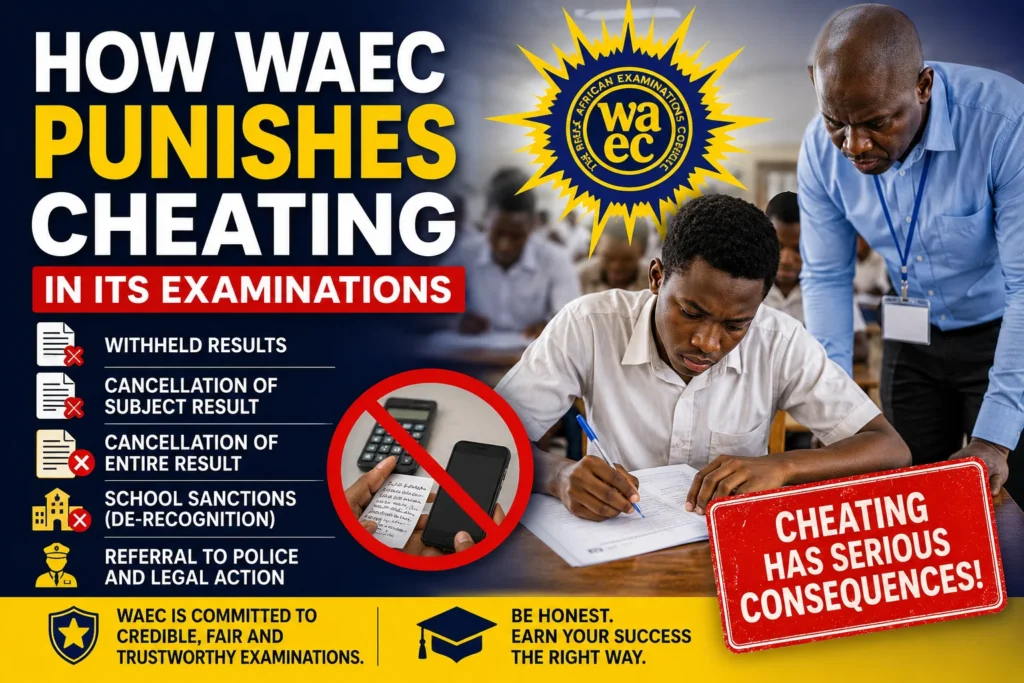
In Ghana, WAEC does not simply cancel a candidate’s paper the moment an irregularity is reported. Depending on the nature of the offence, the Council can withhold results, investigate the case, cancel individual subject results, cancel an entire examination result, sanction schools and refer serious cases to law-enforcement agencies.
WAEC’s own regulations make it clear that candidates suspected of examination malpractice can have their results withheld while investigations are conducted. Candidates found culpable are then sanctioned, while candidates found innocent can have their results released.
This means that a candidate who cheats may not immediately know the final punishment. In many cases, the consequences become clear only after WAEC has completed its investigations.
What examinations does WAEC administer in Ghana?
Before looking at how WAEC punishes cheating, it is important to understand the major examinations administered by the Council in Ghana.
According to WAEC Ghana, its National Office conducts three major groups of examinations for the country:
- Basic Education Certificate Examination (BECE) for School and Private Candidates.
- West African Senior School Certificate Examination (WASSCE) for School and Private Candidates.
- Business Certificate Examinations, comprising the General Business Certificate Examination (GBCE) and Advanced Business Certificate Examination (ABCE), also for School and Private Candidates.
WAEC also administers customised aptitude tests for purposes such as admission into training institutions, scholarships and employment.
The BECE is particularly important because it serves both certification and selection purposes for progression into Senior High Schools and Technical Institutes in Ghana.
The WASSCE, on the other hand, is administered for both school and private candidates. Private candidates can enter for one or more Core and/or Elective subjects, depending on the available combinations.
The GBCE is equivalent to the WASSCE, while the ABCE is an advanced business qualification with diploma and single-subject entry options.
What does WAEC consider examination malpractice?
Examination malpractice is not limited to copying another candidate’s work.
WAEC’s rules cover a wide range of actions that can compromise the integrity of an examination.
These include bringing foreign materials into the examination hall, possession or use of mobile phones, collusion, copying, leakage of examination questions, prior knowledge of questions, posting live examination questions on the internet and other forms of dishonest assistance.
WAEC has also introduced revised rules covering matters such as inscriptions on the body or clothing, posting live questions online, misconduct by examination officials and the multiple registration of candidates in public and private schools.
In its 2024 WASSCE investigation, for example, WAEC reported cases involving candidates bringing foreign materials into examination halls, taking photographs of questions and posting them on social media, distribution of photocopied responses and invigilators assisting candidates.
Therefore, a candidate does not have to be caught physically copying another person’s answer before WAEC can take action.
1. WAEC can withhold a candidate’s results
One of the first major consequences of suspected examination malpractice is withholding of results.
When WAEC has reasonable grounds to suspect that a candidate may have been involved in malpractice, the Council may withhold the candidate’s results while investigations are conducted.
A withheld result does not automatically mean the candidate has been found guilty.
WAEC explains that a result is withheld when the examination has been officially released but the particular candidate’s result has not been released because the candidate is being investigated for alleged malpractice. The result can subsequently be released if the candidate is cleared.
This distinction is important.
Withheld does not necessarily mean cancelled.
A candidate may have to wait for WAEC to complete its investigations before knowing whether the result will eventually be released or cancelled.
2. WAEC can cancel the result of one subject
Where malpractice is established in a particular subject, WAEC can cancel the candidate’s result in that subject.
This is particularly serious because the candidate loses the result earned in that paper.
WAEC’s handling of the 2024 WASSCE for School Candidates provides a clear example.
After investigations were completed, the Council cancelled the subject results of 4,108 candidates for bringing foreign materials into the examination hall.
This demonstrates that the punishment can be targeted at the affected subject rather than automatically wiping out every result the candidate obtained.
3. WAEC can cancel the entire examination result
Some forms of malpractice can lead to a much more severe punishment: cancellation of the candidate’s entire examination results.
Again, WAEC’s 2024 WASSCE case provides a clear example.
The Council cancelled the entire results of 483 candidates for possession of mobile phones in the examination hall after the relevant investigations and approval processes were completed.
This is why candidates should never assume that simply carrying a mobile phone into an examination hall is a minor offence.
WAEC has repeatedly warned candidates about its strict position on mobile phones and other electronic communication devices at examination centres.
4. WAEC can withhold individual subject results
Not every case results in immediate cancellation.
WAEC may also withhold the result of a particular subject while investigating an alleged irregularity.
In its review of the 2024 WASSCE cases, the Council reported that 781 candidates had subject results withheld after investigations had been initiated.
In some cases, examiners themselves can raise concerns after discovering possible collusion or similarities in candidates’ scripts during marking.
This is important because a candidate may leave the examination hall believing that everything went well, only to discover later that the result has been withheld.
5. WAEC can withhold the entire result
Where the suspected offence is considered serious or affects the candidate’s examination generally, WAEC can withhold the entire examination result.
For the 2024 WASSCE, WAEC reported that the entire results of 209 candidates were withheld for various suspected offences.
The affected candidates then go through the Council’s investigation process.
WAEC says candidates are given an opportunity for a fair hearing before final decisions are made in cases where malpractice is alleged.
6. WAEC investigates suspected collusion
Another important form of malpractice is collusion.
Collusion occurs when candidates work together in an unauthorised manner instead of independently answering the examination questions.
The Council can identify possible collusion not only from what happens inside the examination hall but also during the marking and checking of scripts.
WAEC’s official information shows that examiners can identify suspected instances of collusion in candidates’ scripts, leading to the withholding of results and further investigation.
In 2025, WAEC also published lists of candidates who were allegedly involved in mass collusion during the BECE and invited them to assist the Council in concluding its investigations.
This shows that escaping detection at the examination centre does not necessarily mean escaping punishment.
7. WAEC can sanction an entire school
Examination malpractice is not treated as an issue involving candidates alone.
Where a school is found to be involved in malpractice, WAEC can take action against the institution.
The Council has warned that private schools involved in examination malpractice can be derecognised. WAEC has also stated that heads of public schools may be referred to the Ghana Education Service for disciplinary action and other available legal remedies where their schools are involved in malpractice.
WAEC’s terminology also distinguishes between de-recognition and withdrawal of recognition. Under its regulations, a school involved in mass cheating can be de-recognised, while withdrawal of recognition can prevent the school from presenting candidates as a school centre and may result in the withdrawal of the centre number.
8. WAEC can sanction examination officials
Candidates are not the only people who can be punished.
Invigilators, supervisors, teachers, school authorities and other examination officials can also face consequences when they participate in or facilitate malpractice.
WAEC reported that the 2024 WASSCE investigation uncovered cases in which invigilators assisted candidates in examination halls. Some cases considered criminal in nature were reported to the police for appropriate action.
During the 2025 WASSCE, WAEC also reported cases involving the distribution of photocopied answers and other irregularities, warning that it would not hesitate to apply the full force of the law against school authorities undermining the credibility of the examination.
9. Some cases can be referred to the police
Not every examination offence remains an internal WAEC disciplinary matter.
Where an alleged malpractice case has a criminal dimension, WAEC can involve the appropriate security or law-enforcement agencies.
In its report on the 2024 WASSCE, WAEC said some cases of a criminal nature were reported to the police for appropriate action.
This means that people involved in serious examination malpractice could face consequences beyond the cancellation or withholding of examination results.
10. WAEC can act against mass cheating
WAEC takes an especially serious view of mass cheating.
Its regulations define mass cheating as a situation where more than half of the candidates for a subject at a centre are involved in collusion.
Where mass cheating is established, the consequences can extend beyond individual candidates to the school or examination centre.
The Council may scrutinise scripts from affected schools and take action against the institution where the evidence supports such action.
During the 2025 WASSCE, WAEC said scripts of candidates from schools reported for involvement in irregularities would be scrutinised.
11. WAEC can publish names of candidates involved in investigations
Candidates should also understand that examination malpractice investigations can result in WAEC publishing lists of candidates whose results have been withheld or who are required to assist with investigations.
This has happened in both the BECE and WASSCE.
For example, WAEC published lists of BECE 2025 candidates allegedly involved in collusion and instructed them to report at designated venues and on assigned dates.
Therefore, candidates should not assume that once they leave the examination centre, the matter is finished.
What happens after WAEC withholds a result?
The process generally involves investigation.
WAEC’s stated procedure is that, after results are withheld, the Council scrutinises the relevant scripts and investigates the circumstances surrounding the alleged malpractice. Candidates may then be invited for a fair hearing.
After the investigation, the appropriate committee considers the case and makes a decision.
The possible outcomes include:
- Release of the result;
- Cancellation of a subject result;
- Cancellation of the entire examination result;
- Continued withholding where applicable; or
- Other sanctions provided for under the Council’s rules.
WAEC’s FAQ makes the distinction clear: withheld results are subject to investigation, while cancelled results mean a definite decision has been made that the candidate’s performance is null and void because of malpractice.
Why candidates should not cheat
The biggest mistake a candidate can make is to think that cheating is safe simply because the candidate was not caught immediately.
WAEC’s examination security system does not depend only on invigilators watching candidates in the examination hall.
The Council has monitoring teams, examination security arrangements, script checking and post-examination investigations. It has also reported cases discovered during the marking and checking of scripts.
A candidate may therefore complete an examination and only later have the result withheld because evidence of malpractice emerges during marking or investigation.
The safest approach is simple: prepare well, follow the examination rules and write the examination honestly.
A candidate may fail one examination and get another opportunity to improve the result. But an examination malpractice case can lead to the loss of a subject result, an entire examination result, disciplinary action or even legal consequences in serious cases.
Final warning to WAEC candidates
Whether a student is writing the BECE, WASSCE, GBCE or ABCE, the principle remains the same: examination rules are not optional.
WAEC has repeatedly stated that it is committed to protecting the credibility of its examinations. The Council’s 2025 examination briefing also reminded candidates that achieving academic excellence through honest means is possible.
Parents, teachers and school authorities also have a responsibility to discourage malpractice rather than help candidates cheat.
Giving a child a mobile phone to receive answers, arranging outside assistance, helping distribute answers or participating in the circulation of examination questions can create consequences that go far beyond the examination hall.
The lesson is clear: WAEC does not punish only the act of copying. It can punish a wide range of examination irregularities before, during and after an examination—and the punishment can affect the candidate, the school and even examination officials.